


Market Overview
The market has become increasingly divided over the past month. While many of the growth stocks that led the advance earlier this year have experienced meaningful weakness, other major indexes and a broad group of individual stocks continue to display constructive technical behavior.
This divergence creates an important question for investors: Is the recent weakness in growth leadership the beginning of a broader market correction, or is it simply a rotation away from the market's former leaders? At this point, I do not believe the evidence provides a definitive answer.
The charts that follow examine both sides of this debate and explain why I believe patience and confirmation remain the most appropriate approach before making any significant changes to portfolio positioning.
QQQ: The First Signs of Stabilization
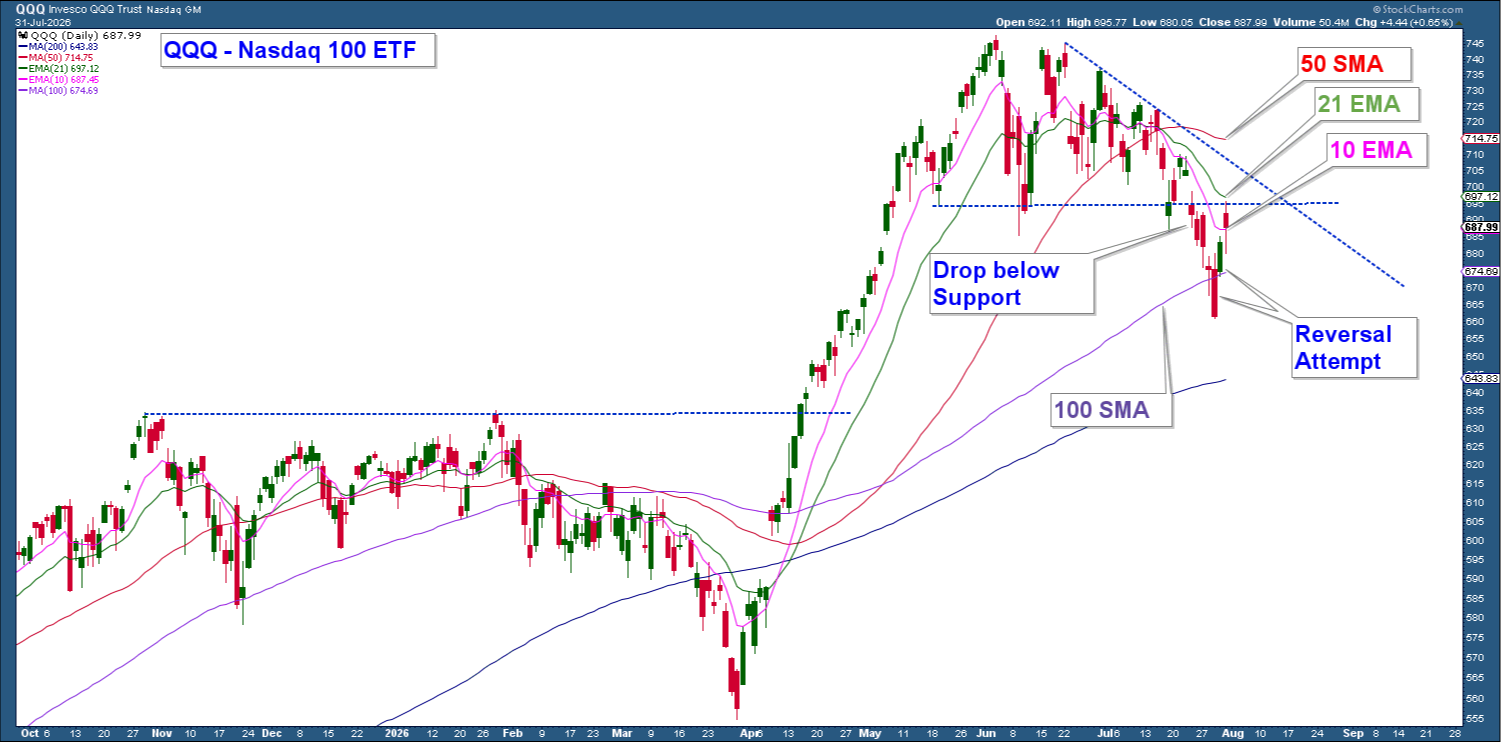
The first chart highlights the recent weakness in the Nasdaq 100, driven primarily by selling in many of the market's former leadership stocks. Recently, the index broke below the lower boundary of its consolidation pattern and entered a short-term downtrend, characterized by lower highs and lower lows.
Last week, however, the index showed its first constructive behavior in several weeks. After a strong move below its 100-day moving average, QQQ reversed higher the next day and was followed by another positive day, suggesting that buyers are beginning to step back into the market at an important area of support. While encouraging, this alone is not enough to conclude that the pullback has ended.
At present, QQQ remains below its downtrend line, below its 21 and 50-day moving averages, and just beneath a prior support level that is now acting as resistance. Until the index can reclaim these important technical levels, I believe it is prudent to view the recent improvement as an early attempt at stabilization rather than confirmation that the correction has ended.
This chart raises an important question: Is the recent weakness in growth leadership the beginning of a broader market decline, or simply a pullback following the powerful advance earlier this year? The remaining charts help answer that question by examining the broader market.
SPY: A Different Picture Emerges
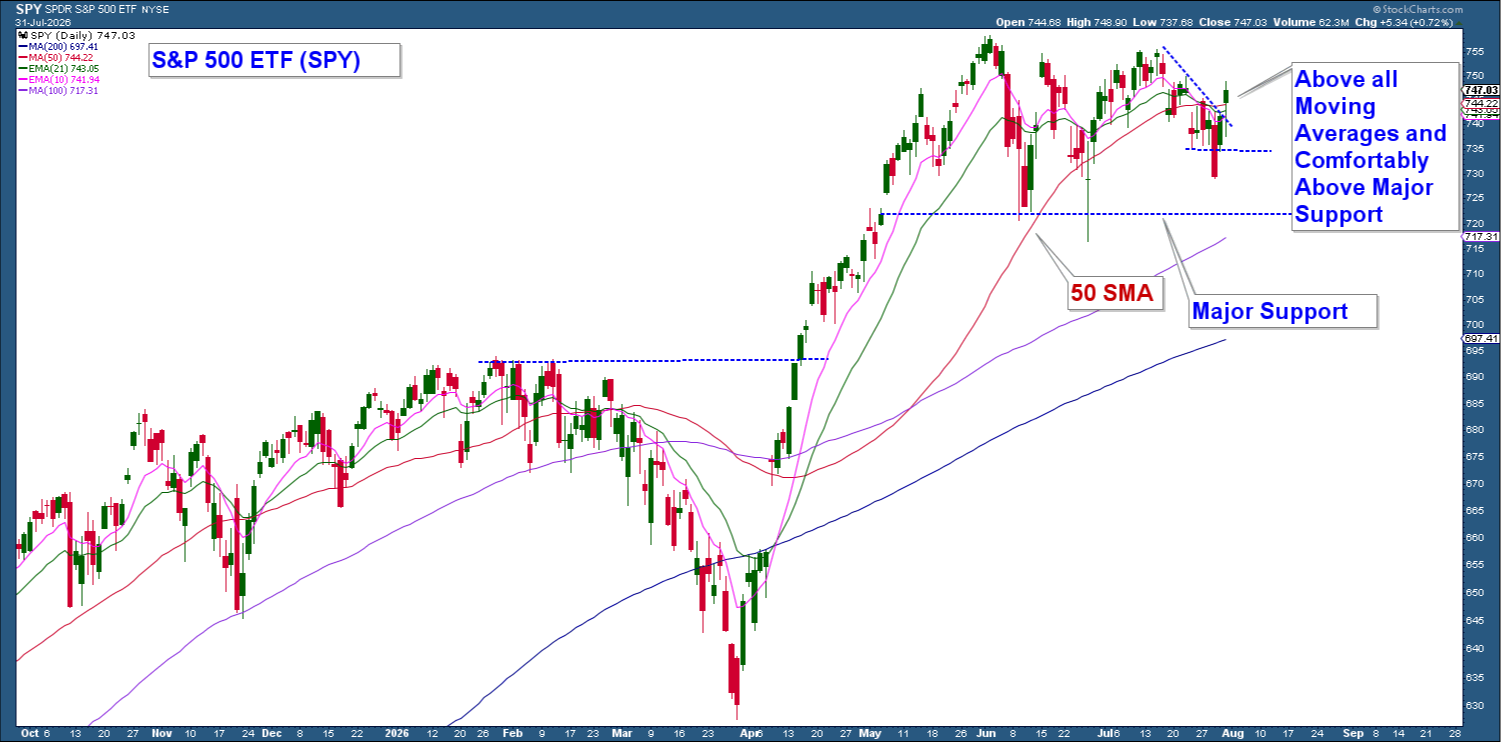
While the Nasdaq 100 has experienced a meaningful deterioration in price action, the S&P 500 tells a different story. Although the index has spent the past three months consolidating in a relatively narrow range, it remains above all of its major moving averages and comfortably above an important area of support.
This distinction is important. If the weakness in technology and AI stocks were spreading throughout the broader market, I would expect the S&P 500 to display a similar technical breakdown. Instead, the index continues to hold above its major support levels, suggesting that the recent weakness remains concentrated in a relatively small group of former market leaders.
Market breadth supports this conclusion. Approximately 62% of S&P 500 stocks remain above their 50-day moving averages, compared with only 42% of Nasdaq Composite stocks. This tells us that, while growth-oriented stocks have weakened considerably, the average S&P 500 stock continues to display constructive technical behavior.
Taken together, this chart suggests that the broader market has not yet confirmed the bearish message being sent by the Nasdaq 100. While continued monitoring is warranted, the evidence currently points toward a correction in market leadership rather than a broad-based market decline.
RSP: The Average Stock Remains Healthy
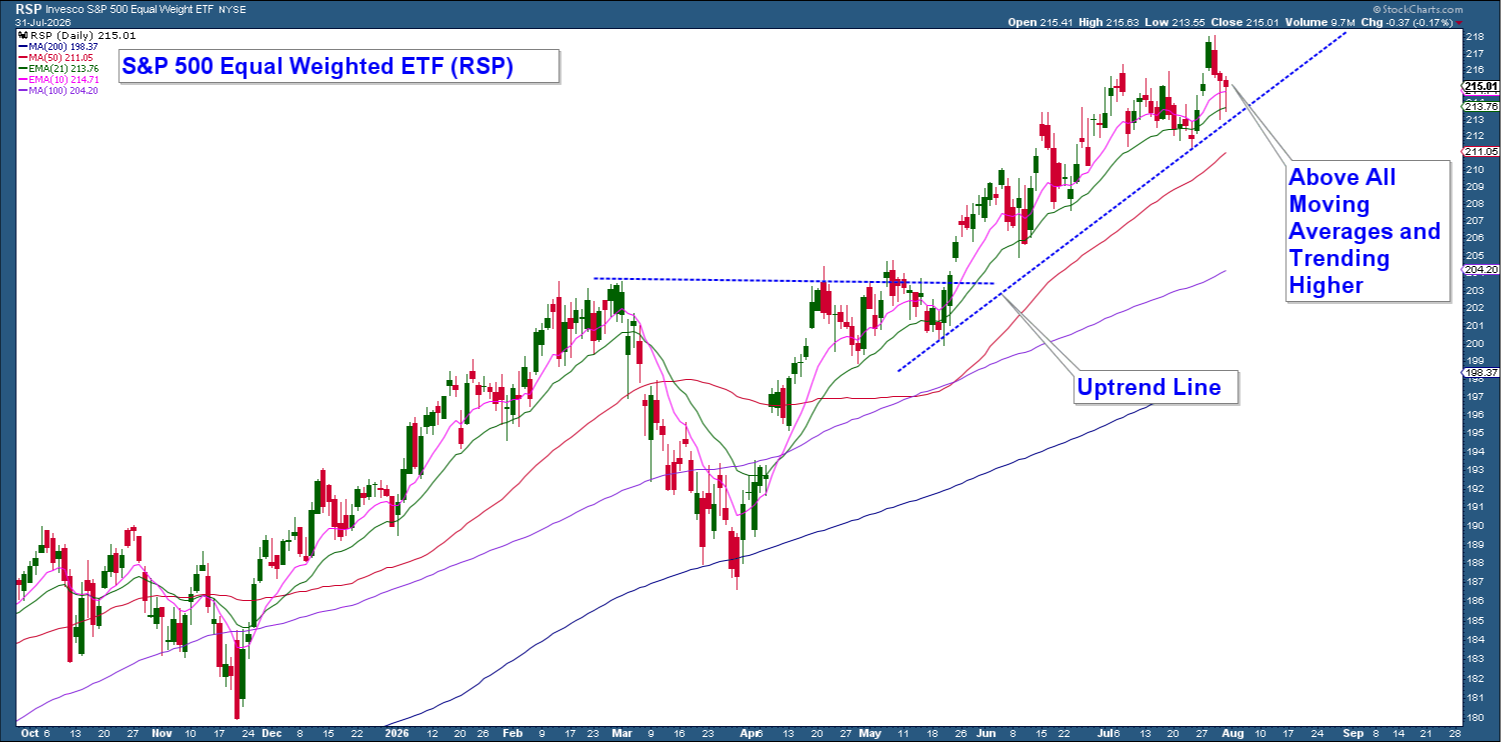
The final chart shows the Equal Weight S&P 500, where every company in the index carries the same weight regardless of its size. Unlike capitalization-weighted indexes, this chart provides a clearer picture of how the average stock is behaving.
From a technical perspective, there is little evidence of deterioration. RSP continues to trend higher above its uptrend line, remains above all of its major moving averages, and is trading very near all-time highs. The 21-day exponential moving average has consistently acted as support, with only brief pullbacks before buyers quickly stepped back in.
This healthy price action reinforces the message from the previous chart. While many former growth leaders have weakened, the average stock continues to display constructive technical behavior. Combined with the fact that approximately 62% of S&P 500 stocks remain above their 50-day moving averages, the evidence suggests that the recent weakness has been concentrated primarily in technology and AI-related stocks rather than spreading broadly across the market.
For now, I believe patience remains the appropriate approach. If QQQ and market leadership begin to strengthen while the broader market continues to hold up well, the evidence would become increasingly supportive of a more aggressive equity allocation. Until then, I will continue to let the market dictate my positioning rather than trying to anticipate its next move.
Client Account Update
Over the past month, I have reduced equity exposure as many of the growth stocks that previously led the market higher broke important areas of technical support. Although the broader market has remained relatively resilient, I believe preserving capital while waiting for stronger technical confirmation is the most prudent course of action.
The recent weakness has been concentrated primarily in many of the growth stocks that previously led the market higher. As those stocks began breaking important areas of technical support, I exited positions in accordance with my risk management discipline rather than holding through deteriorating price action. My objective is not to predict where the market is headed, but to protect capital when individual positions no longer meet my technical criteria.
Looking ahead, I am encouraged by the resilience of the broader market, but I believe additional confirmation is needed before becoming more aggressive. Specifically, I will be looking for renewed technical strength in the Nasdaq 100 and improving price action among leading growth stocks, while also monitoring continued strength in the broader market. If those conditions develop, I will begin selectively increasing equity exposure. Until then, I believe patience and disciplined risk management remain the most appropriate course of action.